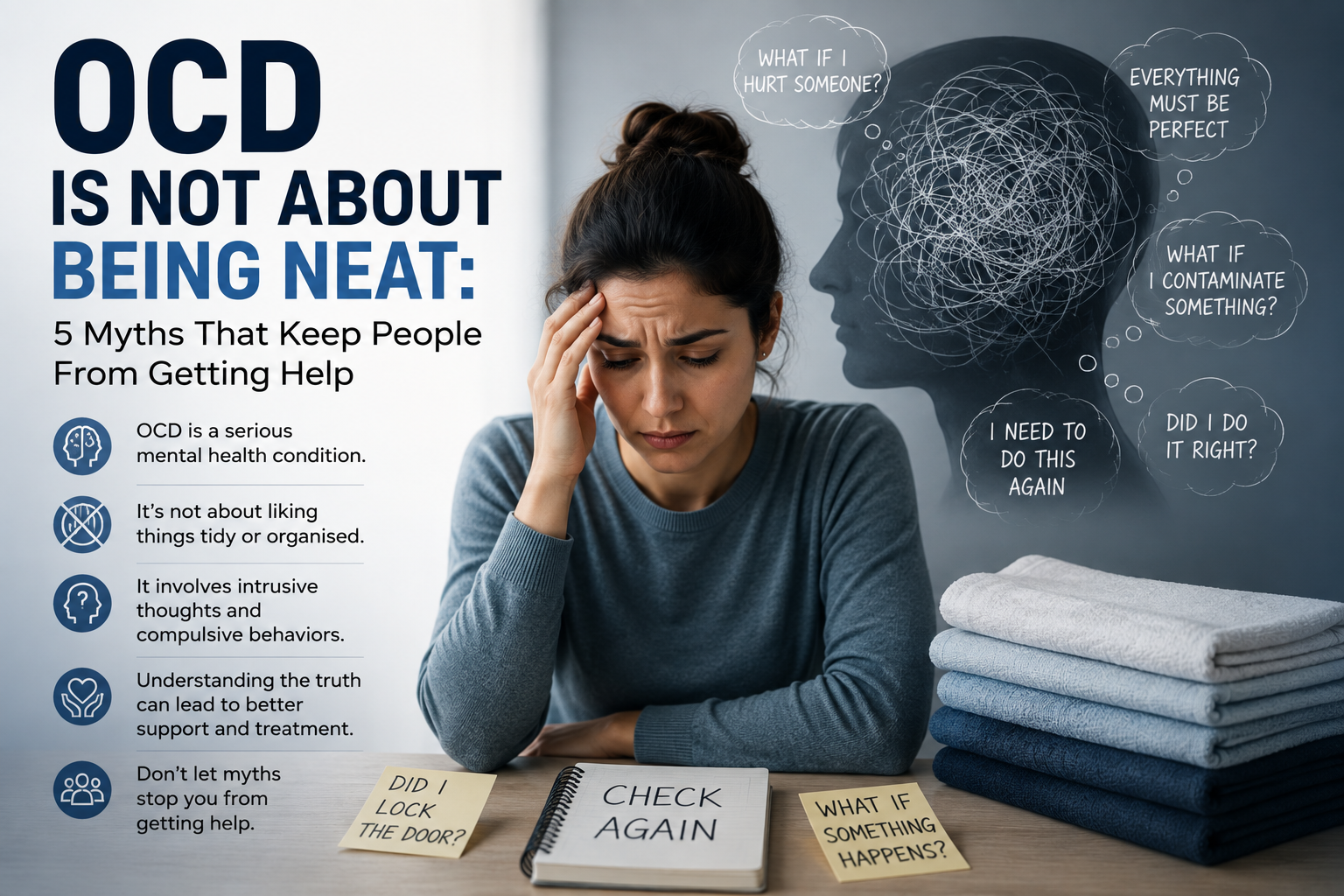
"I'm so OCD about my desk." Most of us have heard someone say it, maybe said it ourselves. It sounds harmless. But that casual use of the word hides how serious and misunderstood obsessive-compulsive disorder really is.
And that misunderstanding stops a lot of people from getting help that genuinely works. Let's clear up the biggest myths about OCD and understand what the condition really looks like.
Myth 1: OCD just means you like things clean and organised
This is the most common one, and it is wrong. OCD is not a preference for tidiness. It is a condition built on two things: obsessions, which are unwanted, distressing thoughts that keep coming back, and compulsions, which are behaviours a person feels forced to repeat to ease the anxiety those thoughts cause.
Someone with OCD might wash their hands until they crack and bleed, not because they enjoy cleanliness, but because a terrifying thought will not leave them alone until they do. That is very different from simply liking a neat cupboard.
Myth 2: People with OCD know their fears are irrational, so they should just stop
Many people with OCD do know, on some level, that their fears are exaggerated. That knowledge does not switch off the anxiety.
Telling someone to "just stop" is a bit like telling someone with a broken leg to simply walk it off. The distress is real and it is physical, not a matter of willpower.
Myth 3: OCD is rare
It is far more common than people think. OCD affects people of every age, background, and profession.
Because the symptoms are often hidden out of shame, most people around the person never know. Plenty of people carry OCD silently for years before they seek help.
Myth 4: It is only about germs and hand-washing
Contamination fears are just one form of OCD. The condition can show up in many different ways, including constant checking of locks or switches, a need for things to feel "just right," intrusive taboo thoughts that horrify the person having them, or a compulsion to seek reassurance again and again.
Two people with OCD can have completely different symptoms. What they have in common is the distressing cycle of unwanted thoughts, anxiety, and compulsive responses.
Myth 5: OCD cannot really be treated
This is the myth that does the most damage, because it keeps people from reaching out. The truth is that OCD is one of the more treatable psychiatric conditions when handled properly.
A specific approach called exposure and response prevention (ERP), a form of cognitive behavioural therapy, has strong results. It gently helps a person face the fear without performing the compulsion, and over time the grip loosens.
Medication can help too, especially alongside therapy. Dr. Satish Kumar shares more on this in his expert opinion on OCD .
OCD is not a personality quirk, a preference for cleanliness, or something a person can simply "switch off." If unwanted thoughts and repeated behaviours are taking up significant time or causing distress, professional support can help.
The real takeaway
If you or someone you love keeps getting stuck in loops of anxious thoughts and repeated behaviours, it is not a quirk and it is not something to be ashamed of.
It is a recognised condition with real, effective treatment, and it is part of the full range of psychiatric care we offer .
Dr. Satish Kumar, an AIIMS Delhi trained psychiatrist , provides specialised OCD treatment using proven cognitive behavioural techniques at his clinics in Noida and Lajpat Nagar, Delhi.
Reaching out is not an overreaction. It is often the first thing that finally helps. Get in touch here .
Ready to talk about what you're experiencing?
You do not have to manage OCD alone. Professional support can help you understand the symptoms, break the cycle of compulsions, and find an effective way forward.
Book an Appointment →